The Paddock Wood Blog Area

The Paddock Wood Blog Area
Wildlife recording & Blogs will be in tetrad TQ6644 - between the marked UK grid lines numbered 66 - 68 (west to east) & 44 - 46 (south to north).

Monday, 11 January 2016

Dangerous snake on the loose !

As a cheery interlude, this snake was spotted among the ground vegetation surrounding the Hop Pocket Pond, when I visited last week


Latin name Cobraei rubberei I think !!!


Quite lifelike though :-).

Sunday, 10 January 2016

Leaf Litter

This is an short extension of the Whetsted Wood post on 2nd January.


When I visited the wood I collected some of the damp leaf litter and set up a home made Tullgren Funnel. This is a simple way of finding what small invertebrates are nestling in the newly fallen leaves.


As you can see, all that is required is a plastic funnel, an old jam jar and a lamp. You then leave the apparatus set up or a few days and see what bugs and beasties emerge from the leaves and fall through into the jam jar...simples :-).

A spent an hour this morning in the kitchen, with my microscope and hand lens, examining the findings.


What was easy to see straight away was a selection of different fungi on the surface of some of the leaves. These fungi are helping to break down the structure of the leaf and so recycle all the nutrients back into the woodland soil.

There were also a number of small soil invertebrates, beetle larvae, spiders etc which unfortunately were too small for me to photograph. However if you are interested in what can be found in the soil you may wish to check out this site http://abugblog.blogspot.co.uk/.

I also found a number of different eggs on the surface of the leaves, deposited by various invertebrates, particularly slug species. 

At the bottom of the jam jar was a small amount of liquid, rain from the damp leaves, which had dripped through from surface of the leaves. Within this water I was amazed to find a number of transparent nematode worms, wiggling about in the liquid.


Ok, I accept this is not everyone's ideal way of spending a Sunday morning, but I was interested to find out what could be found amongst the woodland leaf  litter in winter. As you can see from this very simple and basic investigation, there is life to be found, in what at first sight might seem of little value - dead leaves. But this is the very beginning of recycling the nutrients and carbon stored in last years tree growth. Those fallen leaves spent 6 - 7 months acting as solar panels, collecting the sun's power and converting it into food, which a lot of other life within Whetsted Wood will  rely  upon in 2016. 

It seemed appropriate that if I am to investigate what wildlife can be found within Paddock Wood in 2016 I needed to start at the very beginning and illustrate how life is continually recycling the sun's powers and other elements found within the soil and subsoil of this small part of planet Earth. 

Whilst writing this blog, I am investigating the natural history & wildlife in Paddock Wood for the period of time that it takes the Earth to make one complete revolution around the Sun, but in reality life is a continuous, ever changing event, started 3.5 billion years ago and even in a small inconspicuous place like Paddock Wood there is much to investigate. much to find out about and much to celebrate and enjoy, even hunting amongst fallen leaf litter, for the very smallest of creatures, which most of us never usually see. 

To put it into even greater perspective, there are more bacteria in one teaspoon of woodland soil, than people on this planet and because of the limitations of resources I have available, I wasn't even able to see any bacteria in the small collection of leaves I bought back from Whetsted Wood, only creatures that live off  and interact more directly with that unseen bacteria, than we do.

But at least it's a start ...... :-).


Saturday, 9 January 2016

Drainage Ponds in Paddock Wood

On the 3rd Jan post I mentioned that the number of drainage / retention ponds around the town are expected to increase greatly, if the planned housing developments go ahead. I thought it might be useful to review the existing drainage ponds around the town, which are accessible in public areas.

Publicly accessible ponds around Paddock Wood in 2016


What is a drainage / retention pond?

Historically drainage ponds were often located close to houses built in the lower weald areas of Kent. They helped hold back water in the winter and alleviate flooding, whilst in the summer they reduced shrinkage of the clay subsoil around the house, which could result in subsidence if the soil completely dried out. Additionally they were a source of domestic water for the houses inhabitants and livestock.

Their modern day usage is more often related to flood control in urban areas. In short they are meant to act as a way of storing the urban runoff during heavy rain / storm events and then slowly release the water after the storm has passed. Because they hold water back and reduce its flow, the heavy loads of silt often contained in the storm runoff sinks to the bottom of the pond and so in time the ponds gradually fill up with silt, hold a reduced volume of water and so prove to be less effective, unless they are de-silted on a regular basis.
All ponds are dynamic habitats, by which I mean they are very quickly colonised by plants and animals and within 2- 3 years you have a thriving wildlife habitat. By way of comparison, mature woodlands take up to 200 years to become a well-balanced ecosystem.

The Hop Pocket Pond (pond E on the map)

Let’s start with the oldest drainage pond I am aware of, the pond near the railway bridge ( & The Hop Pocket pub before it was demolished). Here are a few photos :


( Photo taken in July 2006, 
but trolleys still migrate to the pond !)


Lovely isn’t it !

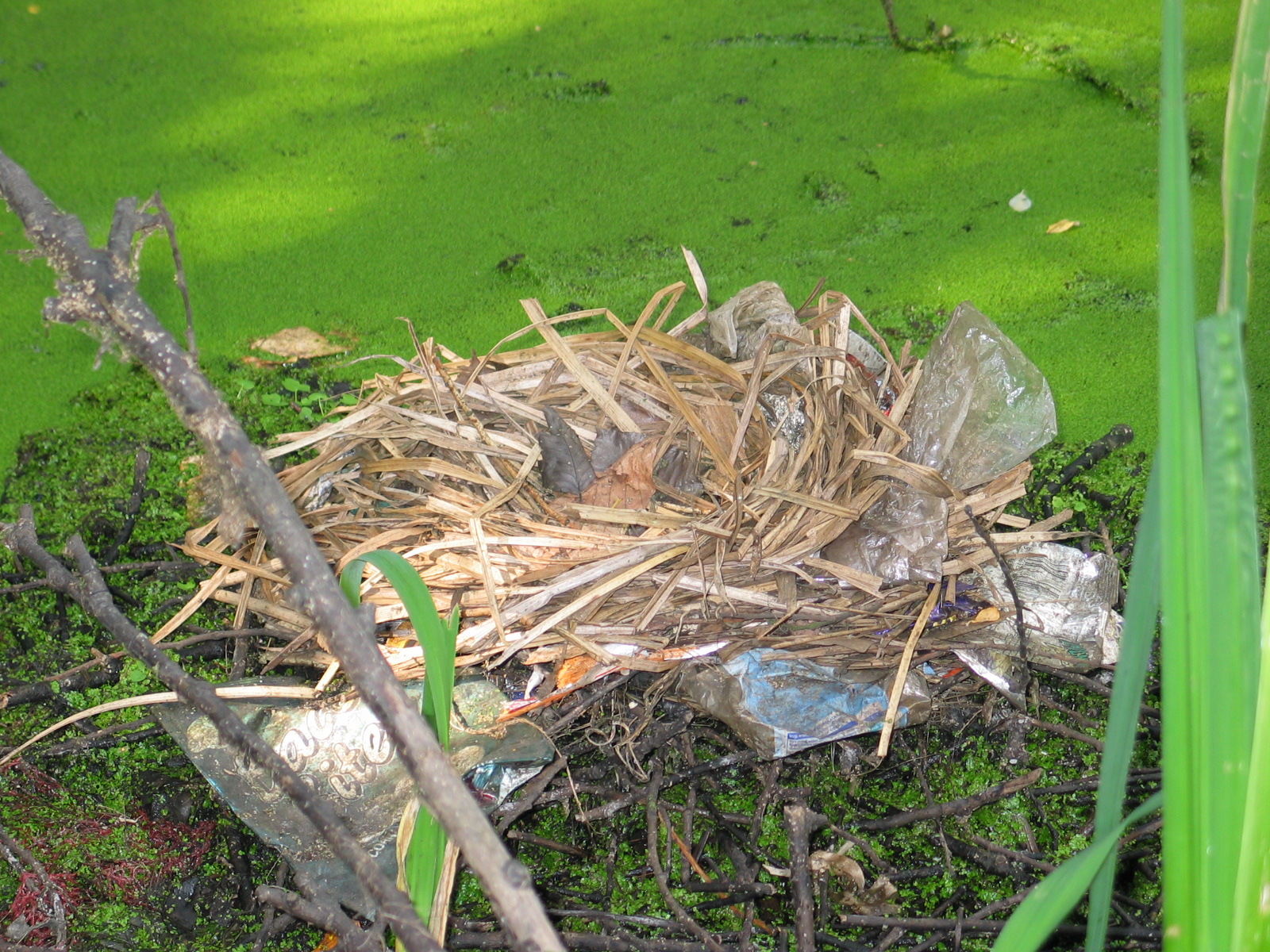
As you can see it is heavily shaded and the large amount of duckweed indicates probable high levels  of nutrients. Technically it is in the ownership of Network Rail, but it has been neglected for many years now. I have never felt brave enough to plumb the depths to see what lives underwater, but in past years I have seen the odd moorhen and a few frogs in the pond. Ever wondered how best to recycle rubbish? If you are a moorhen you build a nest with all the food wrappers and wastepaper !

A rubbish builder !

I think this is probably the earliest public drainage pond in the town and probably was constructed when the railway bridge was built, in the mid 1800’s.The water draining into it mainly comes from the surrounding roads and car park.

Putlands Ponds (pond(s) A on the map)

Moving swiftly on to the next oldest drainage ponds, there are two ponds behind the Putlands sports hall and next to the Bowls club. Both were built in the late 1970’s / 80’s. 

The smaller of the two, behind the sport hall, is filled by drains from the sports hall car park and the adjacent housing estate (Linnet Avenue & Chaffinch Way). 

Spot the ball competition !


It’s quite deep and reasonably vegetated & has the odd moorhen (& football)  and sometimes mallard ducks on or around its margins. In late February the pond is a magnet for frogs trying to breed and on average 30 - 40 clumps of frogspawn can be seen in the pond at this time. There are also fish in the pond, so the tadpoles may well struggle to transform themselves into little froglets !

The largest of the two ponds, behind the bowls club, is central Paddock Wood’s best toad breeding pond. 

Looking east across the pond


In some years I have counted upwards of 800 toads at the height of the breeding frenzy in early – mid March. This pond is designated, by the Kent Reptile & Amphibian Group, as a toad breeding site of county importance. Toads are very faithful with their breeding ponds and return year after year to the same pond (or adjacent ponds). The main pond in Putlands is one such pond. Nationally toad numbers are rapidly diminishing, partly as a result of destruction / pollution of their breeding ponds. It is likely that most toads within to 0.75 – 1 km of the Putland ponds converge on these two ponds to breed each year in early March.

Looking briefly at other wildlife matters regarding this pond, smooth newts can also been found and there is also a small moorhen population. After the circus comes to town, in July, a burgeoning goldfish population becomes resident within the pond ! The high level of fish does result in a diminished population of aquatic insects in the pond, as the fish are the top predators in this watery jungle.

In recent years PWTC have arranged to have the trees around the pond to be cut back and the area behind the pond made more wildlife friendly. This has worked, because in spring 2015 large numbers of toads appeared to have hibernated in this area. Additionally the aquatic vegetation has been thinned to provide larger areas of open water. In the past there has been large amounts of duckweed in this pond, plus at times an explosion of Costa coffee cups and other litter. The joys and perils of an urban pond !

The main drainage feeding into the pond, comes from the adjacent sports field, via a drainage ditch and also from the smaller pond mentioned earlier. The water exits into the drainage system in ‘The Bines’ and remains underground until reaching the culvert opposite the John Brunt Pub. 

Some 7 – 8 years ago a large number of toads appeared in this culvert, after excessive rain one spring. Toads were migrating to the Putlands ponds at this time and many do fall into the roadside drain gully pots around Kiln Way / Ashcroft Road / The Bines / Chaffinch Way areas. The toads seen in the John Brunt pub culvert may well have been washed through from the Putland ponds, or the drain gully pots in the previously mentioned roads.

The silt removed from the pond in December 2015


After years of flooding problems, in December 2015 the pond was de-silted and I am waiting to see how this will affect this year’s toad breeding season. Most of the fish were also removed and I am not yet sure if they are going to be put back into the pond. If not, there may be a higher number of aquatic insects in the pond this year.

The Green Lane Ponds

Sorry, this is turning out to be rather a long blog and so at this stage I will skate over these three ponds and come back to them in greater detail in a latter blog.

There is a large pond on the main sports field (pond B on the map) which receives drainage water from part of the Green Lane housing development (see drainage map in blog dated 3rd January) and like the other two ponds was built in the 1990’s.

Looking south east from the playing field.


I am aware of great crested newts in the garden ponds of some of the nearby houses, but so far have not found them in this pond. The pond has small fish, stickle backs, and so this could well be the reason. The sides of the pond are also very steep and access is difficult, making a wildlife survey of the pond a challenge.

At the junction of Green Lane and Church Road there are two additional drainage ponds, both of which are fenced off, restricting access, as is the pond on the sports field.  

Looking north east, towards the modern cemetery.

One pond is quite small (pond c on the map) , contains a duck house ( a donation from an MP maybe!) and heavily covered in aquatic vegetation, but looks like it has good potential as a wildlife pond.

View from Green Lane, looking west.


The larger pond (pond D on the map) has much more open water, as a result of the removal of large amounts of common reed plants (Phragmites)  3-4 years ago. Before this there was always a good population of frogs breeding in the pond. The phragmites  has begun to re-establish itself around the margins, so it will be interesting to watch if the frogs will return in greater numbers this spring.


I will end this blog for now and return to them in early spring, once the amphibian breeding season begins. However, at least for now, readers have a brief understanding of the main public accessible drainage ponds in the pond.

Thursday, 7 January 2016

Birds of Paddock Wood : The Treecreeper

For many years now I have loved to watch treecreepers (Certhia familiaris)  in the woodlands around the town. The best place I know to see them (within our recording & blog tetrad - see 'The Paddock Wood Blog Area'), is in Foal Hurst Wood nature reserve, on the south west border of the town. 


In the winter, when the trees are bare, you can watch them hunting for tiny snack-sized morsels of food, among many of the larger oak trees to be found within the wood. Mouse like in size and movement, treecreeper's actions match their build; delicate and dainty. They feed on the smallest of mini beasts. Spiders, insects, weevils etc are their prey and they use their curved, needle like, beak to winkle out their prey from the deep within cracks and crevices to be found on a  large oak tree.

They hunt in a methodical way, flying to the base of a large oak and then hopping up the main trunk in a spiraling motion, ever up wards until they reach a large limb of the tree, where upon they often follow the underside of limb towards its thinning branches. To help them hold on to  the tree’s bark they have outsized, but slender feet, with long gripping claws, plus strong stiff tail feathers for extra balance.

A mottling of dark & light brown, plus splashes of black and cream patches on their backs, provides them with the perfect camouflage, when they are still; which is not often. But it is their silky white underside that gives a softness to their appearances and endears to them to you.

One of the town's residents, Cathy, loves taking photographs of birds she see's in the countryside surrounding the town and she is kind enough to share these with me. Through hours of patience she captured this photo of a treecreeper, hunting for spiders in the trees crevices. Cathy's original photo is pin sharp and shows the bird in fantastic detail. To protect Cathy's copyright on the photo I have used photoshop to 'scramble' & reduce the photo somewhat, but you get the idea.


In the winter Treecreepers can still be seen fairly easily in the pockets of woodland around the town. Indeed, within Foal Hurst Wood, the volunteers who look after the wood, have erected special nesting boxes for the birds to breed in. 

I hope they continue to remain a part of the town's wildlife treasures for many years to come :-)


Sunday, 3 January 2016

Geology & Hydrology


Today is another day of mild temperatures and heavy rain :-(. Tomorrow it is due to rain again, which allows a timely investigation of the geology and hydrology of the area, for it has quite a bearing on the natural history of the town.

Geology

Paddock Wood lies on a flat area of county, just 17 metres above sea level, which is part of ‘The Weald of Kent’. 


The town sits on a bedrock of Wealden Clay, topped off with a deposit of river silts and gravels, from the nearby River Medway. The Wealden Clay bedrock was deposited approximately 120 – 135 MYA, when the area was a small, shallow, tropical sea.

The name ‘Weald’ gives a clue to its historical use and natural vegetation cover. ‘The area was known to the Britons as Coed-Andred, Coed being the British word for wood. The Romans called it Silva-Anderida (Silva being latin for wood or forest). The word ‘weald’ also signifies in Saxon language a woody country or forest. The Saxons thus called it ‘Andredsweald’, for it retained the name of Andred for centuries after the Romans abandoned Britain (Archaeologia Cantiana Vol. 14 -1882  pages 38).

The small pockets of woodland dotted around the town are the remnants of this great ‘Andredsweald’ which for millennium covered a large area of the counties of Kent & Sussex and also parts of Hampshire. In Saxon times much of the extensive woodland around Paddock Wood was used extensively as 'pannage' -  autumn foraging for the local swine herds.

Whilst the weald clay soils around Paddock Wood provide poor drainage and are noticeably slow to warm up in the spring,  these conditions are excellent for the native English Oak trees (Quercus robur), which formed much of the Andredsweald of old and continue to form the basis of the small pockets of woodland found in the countryside surrounding the town.

Hydrology

The land occupied by Paddock Wood is flat and in the winter wet, flooding fairly easily; indeed many of the fields had surface water showing on them today, after just a few days of rain. 

As the following map shows there are parts of the town designated by the Environment Agency as either flood zone 2 - a 1 in 200 year river flood event (light blue), or flood zone 3 – a 1 in 100 year river flood event (darker blue). With climate change expected to pay a greater influence upon our weather patterns, as this century progresses, these flood zone designations may have to be amended, to include designations for more frequent flood events.

Fluvial flood map of Paddock Wood


In addition, the town's current drainage infrastructure is inadequate and causes urban runoff flooding in parts of the town. The following map shows the main surface water drainage system (blue & red), but also the natural drainage ditches and streams (purple & green) for area of this blog . As can be seen the main drainage streams (purple) are (west - east) : Tudeley Brook / Gravelley Way /  the West & East Rhoden Streams.

Surface drainage map of  Paddock Wood


Flooding remains a great source of debate among local residents, particularly regarding the wisdom of allowing further development in an area known to be prone to flooding. Of interest to the future changes in the natural history of the area is the planned extensive use of drainage ponds, which are currently proposed within the three main large housing developments planned over the next 10 years.

As I will report in future posts, because of its natural & man made drainage structures Paddock Wood is an already an attractive habitat for amphibian populations (frogs, toads, newts) in the area. Should there be a considerable increase in the number (& area) of drainage ponds then I would expect a further increase in the amphibian population living within the town & surrounding countryside.


So there you have it, a brief summary of the geology and hydrology of the area, with clues to how this affects the natural history of the area, as we may discover as the year progresses.

Saturday, 2 January 2016

Whetsted Wood Winter Scene


Ok, exploring the landscape let’s start with a small slice of woodland in the northwest segment of the recording area, called Whetsted Wood.


The wood is sliced in two by the main railway line and the northern section is on private land and so not easily accessible. The southern section of the wood has a public footpath & field ditch along its southern boundary and the Tudeley Brook running along its eastern edge.

Historical Use

 1940 View

 1960 View

 1990 View


As can be seen in the photo maps above, from the Google Earth Timeline feature, the southern section of Whetsted Wood is really a small copse, with a history of past coppicing, which seems to have ceased in the late 1980’s. The northern section appears to have been allowed to become permanent woodland habitat, since the 1940’s and extended westwards into an adjacent field.

January 2016

I approached the wood using the public footpath from the Allington Road housing estate which, subsequently crossed an arable field, currently planted with kale. The back gardens of the houses / arable field margin, marks the edge of the ‘green belt’, a 1950’s planning designation, indicating that further development is not allowed beyond this line. So currently the town cannot expand further in a westerly direction.

Exploring the accessible southern section of the wood, the woodland is a mixture of young‘standard’ oak trees (Quercus robur) and an under-story of coppiced ash & hazel trees, plus a smattering of hawthorn, birch, holly, field maple, with willow and aspen / poplar trees along the wetter boundaries. One or two trees have blown over in the past, but there is not much dead wood on the woodland floor.


The view from the Tudeley Brook, looking west.

There is also little in the way of a shrub layer and so the view is quite open in the winter. Although freely seeded young birch trees, growing close together, give the western end of the wood a less open vista. Additionally, I noted a larger area of bracken near to the western end, but at present very little ground vegetation is on view.


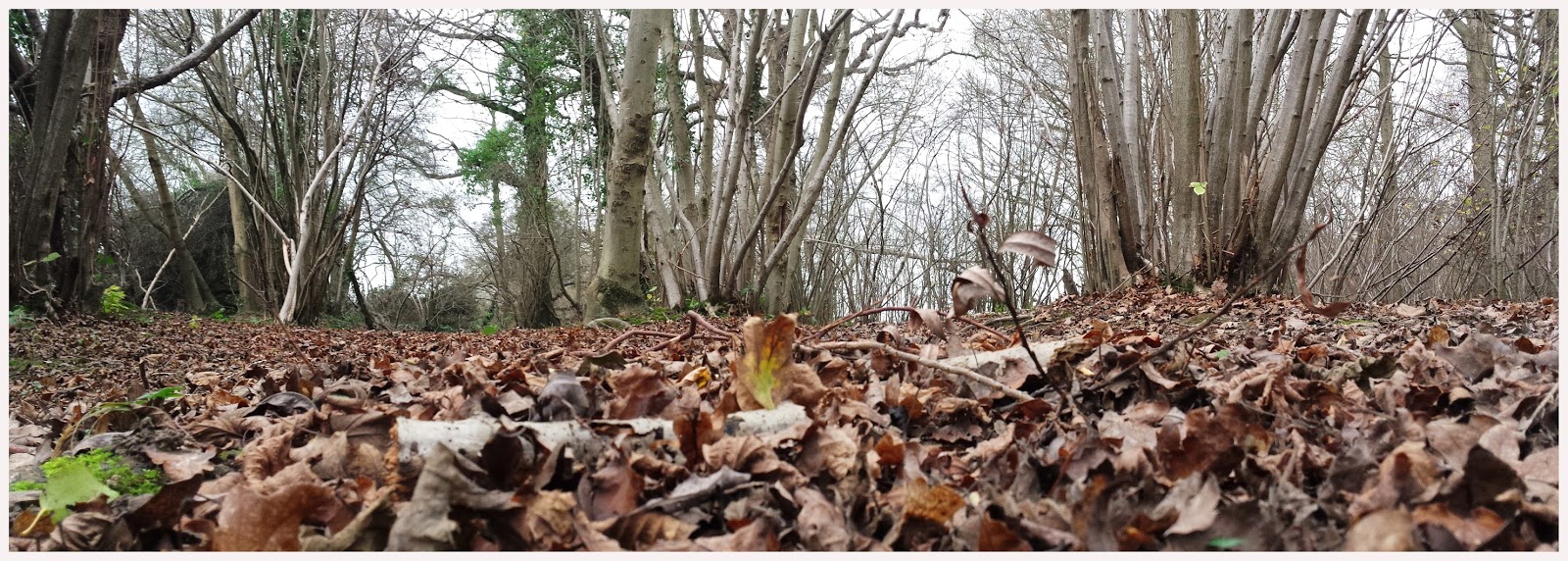
Worms eye view !

Underfoot it is damp, due to the clay soil, which dominates most of the Paddock Wood area. Although as the photographs show, there is a rich layer of leaf litter on the woodland floor.


The Tudeley Brook was very shallow at the time of my visit, no higher than mid-calf on my wellies. Although, as can be seen in the photographs, the banks of the brook / stream indicate a much higher water level can be expected during heavy, or prolonged, periods of rainfall. 


Two views of Tudeley Brook


The stream bed was a mixture of clay silt , with occasional riffles of gravel. There was little stream vegetation, probably due to shading from the trees and the steady water flow. Starwort species could be seen in places and the odd ‘log jam’ from fallen tree branches etc. Birds are attracted to drink from the stream, with chaffinch, wood pigeon, blackbird, wren, blue tit and great tit noted.


The wood appears to have a number of resident robins, with a coppiced hazel tree used as a regular singing post (where the Tudeley Brook leaves the wood under the railway line) for one male bird.


Songster in mid tweet.

The rain became more persistent as the afternoon progressed and daylight faded, so this bought an end to the exploration of Whetsted Wood for the meantime.


Sunset over the fields.

I will explore the wood, plus the surrounding arable & grass fields, at a later date and provide an update on the wildlife of the area, as the seasons change.


Friday, 1 January 2016

The Journey Begins


I went to sleep to the sounds of fireworks exploding in the night time sky and awoke to the sound of a single song thrush heralding the arrival of dawn; just like a lone piper on the turret of a remote Scottish castle. 

Song thrushes have had a hard time of it over the last 30 – 40 years or so, however they still cling on here in Paddock Wood, although in diminished numbers.  It’s good to hear their wonderful song first thing in the morning, especially during the spring time.

With December 2015 being the warmest December since weather records began I was surprised to see a slight frost on the lawn this morning. 


It will be interesting to see if the exceptionally mild weather conditions will continue this month. In September last year the newspapers were writing that the met office were predicting that this winter would be the coldest for a very long time. Plenty of time to see if they will be correct, or not.

Along with the song thrush I was pleased to see and hear the flock of Jackdaws celebrating the new year, above the skies of the western side of the town. Jackdaws are a recent regular addition to the town’s nature scene. Yes they have been around for quite a few years, but their numbers are now such that for the last year I have seen and heard them every day and they are such a pleasure to behold. My favourite member of the crow family, although recent DNA analysis is now casting doubt as to whether they are a true corvid or not. 


If you watch and listen to them they are like children playing in the school yard at break time. Never still, always ducking and diving  in the sky, calling to each other in an excited fashion. Occasionally they stop on a nearby roof and then they are off again for another game of ‘Jackdaw tag’ !


Well my time is limited today, so that’s it for now, but at least it’s a start on nature’s ride through Paddock Wood during 2016.