The Paddock Wood Blog Area

The Paddock Wood Blog Area
Wildlife recording & Blogs will be in tetrad TQ6644 - between the marked UK grid lines numbered 66 - 68 (west to east) & 44 - 46 (south to north).

Tuesday, 3 May 2016

Sunset serenade


Sunday 1st May was a lovely warm sunny day, the first really warm day this spring, after an April which was dogged by cold winds from the north or north east for much of the month. Perhaps the weather pattern is changing and an overdue warm spell is heading our way. I do hope so.

Two weeks earlier I had seen the sun rise and listened to the dawn chorus in Foal Hurst Wood nature reserve, but I had been waiting for the right opportunity to hear the birds as they serenaded the closing of the day and settled down to sleep. Although it was too cloudy to see the sun set on Sunday it was warm enough for me to sit still in the wood for 75 – 90 minutes and listen to the chorus of birdsong, as the light dwindled.

Sunset was forecast for 20.20 BST, with dusk forty minutes later at 20.58 BST, so I arrived at the wood at 20.00 hours, as the performers were tuning up for the main event. Walking through the wood to my chosen spot I heard blackbirds, robins & wrens singing loudly from the many trees throughout the wood. I am sure it was just my perception, but the songs seemed a little less rushed and gentler on the ear than the dawn chorus two weeks earlier. Perhaps in the early morning there is an excitement to proclaim the new day, whereas a more reflective mood takes hold in the evening.


Singing wren (Gardenbirds.co.uk website)

After around eight or nine minutes I settled down in my chosen spot, towards the south western area of the wood. I had picked this area as it was further way from the traffic noise of the nearby Badsell Road, which was rather persistent along the northern edge of the wood. Many of the trees had burst their leaves in the last week or so, but the tree canopy was still rather bear, and so was not able to completely muffle the noise of passing cars. I reflected upon how busy this part of the UK is these days!

Singing song thrush (RSPB website).

Listening to birdsong is a little like hearing an orchestra. Some of the performers are loud and sing as if they are they providing a rousing solo performance, the Song thrush – Tudus philomelus -  is one such performer. Every note and phrase repeated three times at full volume, which tends to drown out other performers.  But robins & wrens, small that they are, were not prepared to give up without a fight and sung as if their lives depended on it. The blackbirds’ song was a touch gentler, and more melodic than its nosier cousin, a sweeter tune to hear.  These four bird species provided much of the performance, but one of the joys of sitting quietly in a hidden spot is that the wildlife becomes more accustomed to your presence and the more timid orchestral  members started to play their part, as they serenade the setting sun. Birds like the blackcap & chiff chaff,  who have travelled far to joined the woodland orchestra, provide fine performances that Sunday evening.

A pair of long tailed tits chirped gently for a brief moment and I suspect they had a nest with young, neatly hidden amongst the honeysuckle, draped around some of the birch trees close by.

Four goldfinch flew overhead, twittering noisily as they are want to do. The ‘tinkling triangles’ of the percussion section of the orchestra, maybe.

Two wood pigeons, bassoon players from the woodwind section, cooed gently in the background for around five minutes, all the while the song thrushes solo performance continued to belt out from high above, in the branches of an ash tree.

Further away, behind me,  I heard a pheasant clucking and clattering and crows cawing loudly, sounding like the cymbal had accidentally been dropped in the orchestras pit !  But it was no accident, for a few minutes later a blackbirds alarm call sounded loudly and stridently from the same direction, followed by a wrens alarm rattle. Something was afoot, possibly a fox starting its evening patrol.

It was by now 20.30 and the sun had set. Looking above me, tiny gnats were busily circling my head, attracted by my body heat and the promise of a free blood meal, given half the chance! All I could do was reduced exposed flesh to a minimum and flail away like a windmill, in a hope of keeping them away. Whilst I was busily swatting the gnats, as if on cue, two Common Pipistrelle bats (Pipistrelles pipistrelles) appeared in the woodland clearing in front  of me. ” Hurray, a pair of gnat nibblers”  I proclaimed to no one in particular; my problem might be solved !

Pipistrelle bat in flight (Wikipedia)

For the next ten minutes, in addition to the birdsong, I was privileged to have my own aerial display right above me. Like two spitfire pilots, the bats engaged in their own aerial duel with clouds of midges and gnats higher in the canopy, bent on capturing the flying morsels and filling their tummies with much needed food.

Singing robin (Saga website)

By 20.45 the birdsong had noticeably reduced, as the approaching cloak of darkness started to descend across the wood.  A few wrens and robins continued to sing, but the song thrushes solo performance had by now come to an end. The last songster, a robin, continued until around 20.55, but two minutes later the night patrol began. Two tawny owls started calling to each other across the wood !

I hung around for the next ten minutes listening to the two owl’s intermittent  ’ hooo, hooo, hoo-oo-oo-oo’ hooting and ‘kee-wick, kee-wick’ calls. One bird appeared to be stationary, on a tree near the edge of the wood, whilst the other was flying around and above the wood, judging by the moving sound. In this ‘400 year anniversary of the bard’ it is worth noting that it was Shakespeare who incorrectly wrote down the birds call as ‘tu-wit, to-who’.  It’s never one tawny owl making this sound, always two birds, one calling ‘Kee-wick’ and the other the gentler ‘hoo, hoo’ sound. This is the time for mating and nesting for tawny owls, as well as other birds, so perhaps I was listening to two lovers serenading each other in the still wood around me.
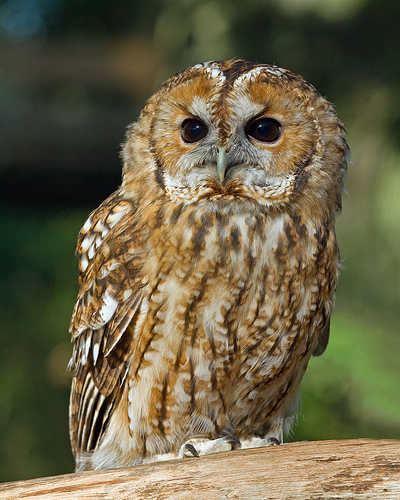
Tawny Owl (wwwfarm5.static.flikr.com)

I nice thought to end on, as I left the wood and returned to hustle and bustle of life in the town.

If you can’t rouse yourself for the dawn chorus, then an evening serenade is a very pleasant (and perhaps more achievable) alternative. Either way, visiting a woodland in the springtime, to hear the birds singing, should be an annual ‘bucket list item’, to boost your spirits and connect with the Earth’s natural rhythms.

Foal Hurst Wood in May

Monday, 25 April 2016

Starling chicks early this year

Since moving to Paddock wood in the early 1990’s, each year I have had starlings nesting in my loft. In all this time only one nest has failed and with each nest producing four or five chicks, I reckon around 100 young starling have fledged whilst I have lived in my house; which is pleasing news.

Adult starling returning with food for the chicks.

However on a European scale, starling numbers have plummeted by an estimated 40 million birds since the 1980’s. Yes, that is 40 million less starlings in the last 25-30 years. If there was a European wildlife profit & loss account, then the figure in the ‘starling column’ would read  minus 40,000,000 !!!

In the UK the population has halved over the same period and in 2002 the starling was added to the UK ‘red list’ of the birds of (most) conservation concern. 

Starling population trend from the BTO website

Nearly fourteen years on we still have no definitive list of the causes for this decline, but agricultural intensification, a move away from mixed farms and indiscriminate use of pesticides must be playing a large part. Starlings feed in pastures and in urban areas, lawns and sports fields etc, using their stout beaks to probe for invertebrates, particularly leatherjackets (cranefly larvae).

Like many other species, since the 1960’s the conversion of the countryside into a food factory, with little space of wildlife, has forced starlings to seek a living in towns & cities, but in drastically reduced numbers. I can still remember walking home from school in the early 1970’s watching vast flocks of starlings flying overhead for minutes at a time, but that doesn’t occur any more, except near to known starling roosting sites.

Anyway, back to my little starling nest, it’s great to watch the adults bringing back food to their rapidly growing chicks and to hear them chirping in the loft, as each food parcel arrives &  I am not the only one in the town have these lodgers every spring. Many of the houses on my estate, built in 1960, have the same gaps under the tiles, which allow the birds access to a safe nesting area. Equally I know of houses in the Green Lane area, built in the mid 1990’s which have the same gaps in the roof design, in which starlings make the most of.

If I had could ask for one wish from the house designers it would be to design the new homes in Paddock Wood with gaps for the starlings to exploit. In that way there would not only be 1000 new homes for people, but 1000 new starling nesting sites as well :-).

A large loft eave area, with gaps for starlings to enter.

Back to the title of this post …’ starling chicks early this year’, compared to previous years they are amazingly early, for normally I don’t hear the chicks until May, at the earliest. The British Trust for Ornithology website state that egg laying usually starts around St Georges Day  - 23rd April, with an incubation time of 12 -15 days. My birds must have starting laying their eggs around 8 – 10 April this year, about fortnight ahead of schedule.

The winter just passed was the warmest since national records began in 1910 and was 2c above average. In fact compared to the Central England Temperature record series (the longest temperature record in the world dating back to 1659) this winter has been the second-warmest at 6.7c, just behind the previous record of 6.8c set 1869.

So although there have been cold arctic winds for large periods this spring, maybe the warm winter has kept the ground temperatures higher than normal, prompting the soil invertebrate population (the starling’s main food) to increase earlier this spring and the starlings are synchronizing their nesting time with this seasonal abundance of leatherjackets etc. in the lawns and open parks around the town.


Who knows, but it’s great to once again wake in the morning to the chirping of hungry chicks; all be it a little earlier this year.

Friday, 22 April 2016

Green Lane Woodland Spinney

Background information

Bordering the edge of the Green Lane housing estate & Mascalls Farm is a small 2 acre (0.83 ha) woodland which can best be described  as a ‘spinney’ .  As far as I have been able to find out and certainly confirmed by viewing Google Earth back to 1940 this spinney has always been here and in exactly the same spot & size. Historically it is likely to have been part of the farm estate which was difficult to manage and so left as a wooded spinney, possibly for hunting rabbits and wood pigeons in the winter.

1940

1960

1990

2015


As seen in 2009

Today it is owned by Paddock Wood Town Council and has had virtually no management for 20 years or so. A public footpath runs through the middle of the wood with a second path entering from Green Lane, midway along the woods length. I produced a report on the wood for the council in 2009 and in the course of preparing the report carried out a few wildlife surveys on the wood. At the time the ground flora certainly pointed to the wood being ancient woodland, indeed in the wood had a fantastic display of spring flowers (bluebells, wood anemone, dogs mercury, violets, garlic mustard, stitchwort, cuckoo flower, primrose etc) all of which confirmed its status as an ancient wood.

A visit on 21 April 2016

Following on from earlier visits to Whetsted Wood and Foal Hurst Wood I thought a return visit to Green Lane Spinney was in order. A chance to see the spring flowers once again.

In a gentle 45 minute walk around the wood for I was able to see the same plant species in flower as in 2009, but there was a noticeable difference, from what I noted in 2009.

The ancient woodland indicator flowers were patchier and less abundant. The flora was more ‘weedy’ with more vigorous plant species seen in greater abundance. The bramble was denser and there was much more grass to be found on the woodland floor, particularly along the main footpath and along the eastern edge, adjacent to the farmland. Additionally the ditch which borders the farmland, which seven years ago as a riot of different flowers, was much poorer in both in different species and number of plants in flower. I also saw hybridisation of garden polyanthus with the closely related primrose plants

 
Primrose & Polyanthus hybrids

I suspect that an increase in nutrients was proving to be beneficial to the ‘weeds’, at the expense of the more delicate woodland plants.

The best area for the traditional woodland spring flowers was in the northwest area, adjacent to the houses numbers 10- 20 in Green Lane, furthest from the farmland.

Bluebells in the north west corner.

Question : Why should have things apparently changed in seven years ?

I wonder if spray drift of fertilisers and/or herbicides from the farmland has had a detrimental effect on the more delicate woodland flowers and allowed the more vigorous plants to prosper. In addition evidence along the path would seem to indicate that dog poo is being allowed to accumulate on woodland floor, which along with dog urine would greatly increase the nutrients available to the woodland plants.

The future ?

It would be a shame if the transformation from ancient woodland spring flowers to ‘weedy scrub’ was to continue.  As was the case in 2009 the wood could benefit from coppicing / thinning of the trees and also the bramble needs cutting back. Should houses be built upon Mascalls Farm, to the east of the wood, then the possible problem of spray drift will disappear, although an increase in more dog owners would do little to resolve the build-up of nutrients from dog waste.


Perhaps it is just that this  is what happens to ancient woodlands in areas of increased urbanisation, human pressures eventually change the make-up of the woodland habitat. It will be interesting to see what happens to this little remnant of the vast ancient forest, which once clothed much of Kent & Sussex for thousands of years, as the years (& increased  houses) roll on.

Wednesday, 20 April 2016

Bluebell Heaven

I visited Foal Hurst Wood to see the bluebells this morning. I could wax lyrical about the sight of so many bluebells in full bloom, the sweet scent drifting across the woodland or the buzz of bumble bees visiting the flowers, but I will just post this picture and say that this is just one small patch of bluebells and there are many, many more equally beautiful displays to be seen throughout the wood.


We are so lucky to have this on our doorstep. Long may it remain so.

P.S. A bumblebee's view of a bluebell :-).

Monday, 18 April 2016

Sunrise & Dawn Chorus

Sunday 17th April : 4.50 a.m. and its cold -minus 2c - and as the darkness lightens I can still see a few stars in the clear sky above Foal Hurst Wood. I am waiting for the first bird to begin the woodland serenade, celebrating the beginning of another day; the dawn chorus.


The previous evening I was thrilled to see a buzzard lift itself from a branch in a nearby ash tree and fly into the sky above the wildflower meadow and drift lazily westwards over the allotments, heading towards the new Orchard Meadow area of the nature reserve. I made a mental note to search the treetops later this week to look for a possible nest.

Back to the cold, which is starting to creep into me, I hope this early rise is worth the discomfort. I hop from foot to foot to warm myself.


Blackbird singing (Zingende Merel)

4.56 a.m. & the light in the eastern skyline is filling and on queue a blackbird releases a few notes, soft and gentle, respecting the early hour. A second blackbird responds and together they serenade each other (& me), marking the end of the night and the approaching sun to lighten the woodland, although the sun’s eventual rise above the horizon will be about an hour away. Last to go to bed and first to rise the blackbirds melodies seem to be the right way to start the day, easy listening.

4.57 a.m. and to my left a collard dove joins the chorus with a gentle cooing, followed swiftly by a robin to my right and 50 metres in front on me, a song thrush, one of the mornings solo artists, begins his polished performance. Vocally strong and confident, he is a star and he knows it !

More birds join in and by 5.10 a.m. the dawn chorus is in full swing, diverting thoughts of my cold feet. A wren shouts is notes to the world, such a powerful performance from such a small bird. A blue tit's gentle ‘tsi tsi’ sound comes from a lower branch and then a crow loudly ‘caws’ from high in the canopy, not so gentle on the spirit !

5.30 a.m. and the performance has been going now for thirty five minutes, with new members of the orchestra joining in. Wood pigeon, great tit, blackcap and then a chiff chaff, the last two birds migrants from lands of southern latitudes, who arrived in the third week of March, although increasingly with mild winters blackcaps are overwintering in the UK more frequently now.

5.45 a.m. and a green woodpecker ‘laughs’ from the adjacent orchard. Although the dawn chorus is full and joyful  & has built to a crescendo, I pick out the gentle tinkling of a goldcrest close by; the merest tap on a triangle, among the full orchestral performance.


5.59 a.m. and the sun shows itself above the horizon. Shafts of light filter through the branches and my shadow casts is cast upon the oak tree behind me, whilst other trees bathe in the morning sun. 


I walk to the edge of the orchard, adjacent to the eastern edge of the wood and watch the sun rise further into the sky. 


Just to emphasis the cold, the grass in the orchard is crisp and white, covered with a sharp frost. I can’t recall many frosts this winter / early spring, so it’s a treat, a cold treat, to see it now, glistening in the sun.


6. 15 a.m and for the last 15 minutes I have just taken in the full majesty of the rising sun, against the background of the music of hundreds birds singing their hearts out. 


I pass through the gate to the wood and return to the wildflower meadow, where I stood the previous night, admiring the buzzard as it took off and glided across the sky. More frost.


6.30am : What a joy it has been to hear the dawn chorus and see the sun rise, something to treasure and to share. I could have listed every bird I heard, but then this would just a list, rather than a reflection of the day. Perhaps by reading this short piece more people will want to rise early, one spring morning and see the day begin, in a way that our ancestors have enjoyed for millennia. Try it, it will give you a new perspective on life.


The Dawn chorus 
by Angela Wybrow 
(on http://www.poemhunter.com ) 

Dawn is the time when darkness becomes light;
A time when darkness disappears from sight.
The ashen veil slowly fades away,
To reveal another brand new day.

Up in the trees, the little birds awake,
And a pretty chorus, they now do make.
There is no other music on earth, quite as sweet,
As their cheerful chorus of twitters and tweets.

To the birds' pretty chorus, I lend an ear,
And am filled inside with joy and cheer.
The little birds are so jolly when they sing;
I wonder if they know of the joy they bring?

It is a treat to hear the birds trilling in the trees;
The sound is carried to my ears, upon the breeze.
Their symphony is carried aloft to where I lay;
Such sweet music, no instrument can ever play.

I do not often wake that early in the morn;
To witness another new day being born.
It is a magical time of the day, I think,
But, I am often still having forty winks.

So, for me, to hear their music is very rare,
But, I consider it beautiful, beyond compare.
Maybe, I should make a date, and set my alarm,
So as, more often, by their songs, I am charmed. 

Thursday, 14 April 2016

Birds of prey sightings in Paddock Wood

For many years the only birds of prey you were likely to see above the skies of Paddock Wood were kestrels and sparrowhawks, but in the last five years buzzards (Buteo buteo) have increasingly been seen in the spring time, gliding on the thermals above the town. Often it is the sound of gulls (more associated with trips to the seaside) which are the first giveaway that there is a buzzard in the sky. For gulls, along with crows and sometimes magpies, appear to take great delight in mobbing the soaring buzzards.

Buzzards soaring in the sky (www.britishbirds.co.uk).

Over the last 25 years buzzards numbers have risen steadily across the whole of the UK, but it has only been in the last 10 years that they have been regularly seen in Kent, but now they are a feature of the Paddock Wood skies, particularly in March & April.  I think they must also be breeding fairly locally, for during the last two summers, juvenile buzzards have been seen resting on trees in Foal Hurst Wood. Maybe this year I will find a nest in one of the woodland trees?

Red Kite, with forked tail (Milton Keynes Natural History Society).

The second bird of prey to return to our skies is the Red Kite (Milvus milvus), but sightings are currently rare. During the winter of 2014-15 a red kite was seen fairly frequently in the Brenchley area. In April 2015 I saw this bird on two occasions sweep past the Old Churchyard & fly over the Waitrose supermarket and then gliding in the skies above the Allington Road area of the town for some time. I have not seen a red kite so far this year, but again like buzzards they are on the increase across the UK and I think it is only a matter of time before they are seen regularly in the Paddock Wood area. They are fairly easy to identify in the sky, just look for the heavily forked tail.

I wrote about Kestrels in a post on 20th February, but suffice to say that hunting areas around the town for this charming, but far smaller bird of prey, are likely to reduce once the planned new housing is built.

Sparrowhawk picnic ! (Wikipedia)

Lastly, the Sparrowhawk (Accipiter nisus), which has been a regular feature of our back gardens since the 1980’s. As my post on 31st January showed if you put out bird food then increasing numbers of small and medium sized birds will flock to the feast you have provided. Theses birds often chatter and chirp as they are feeding and every once in a while they go deadly silent. Two seconds later a sparrowhawk will swoop through the garden at an astonishing speed and garb an unsuspecting bird in its talons and carry it away to feed upon, either from a favoured plucking post, or if the bird is too large (like a pigeon) on your lawn. Sparrowhawks regularly patrol a patch of gardens so don’t be surprised to see them, particularly in cold winters, as the smaller birds move into our gardens to find food.

Last September I found a juvenile sparrowhawk dead on my patio. It had a broken neck and I can only assume it swopped and flew into one of the conservatory windows, which appeared to have a bird imprint dusted on the glass.

Dead juvenile sparrowhawk....

... with amazingly sharp talons.

I guess that given that all the proposed housing schemes are planned to be built upon agricultural land, which as I have written in earlier posts has a more restricted bird population in places, many of the new gardens will attract increasing numbers of birds to feed on the food provided by the new householders. So expect a few more sparrowhawks to arrive as well !

Wednesday, 13 April 2016

Whetsted Wood in Early Spring


On a sunny Sunday morning on 10th April I paid a springtime visit to Whetsted Wood, to view the early spring flowers.


The cold wind, which first appeared in late February ,was playing out its last throws on Sunday and slowly the strength of the sun has started to warm the woodland floor. The half of the wood nearest to the Tudeley Brook was covered in wood anemones & bluebells, both in flower, although the bluebells were a bit early to be honest. I also found a few patches of wild garlic (ramsomes) plants, but they were not in flower.  The western half of the wood has a less open aspect with the trees blocking out the light and so had little in the way of ground flora on show. The paths were also wet and muddy.


The Tudeley brook had a steady flow and signs of the winter floods in December could still be seen. 


The south east facing edge of the wood, which follows the course of the brook was bathed in sunshine and being the warmest part of the wood had many more flowers in bloom than other parts of the wood. Insects, such as bumble bees were easy to find and birdsong could readily be heard in this area (great tit, chiff chaff, black cap, song thrush , blackbird). The rest of the wood was remarkably lacking in birdsong and general bird activity.


Evidence of human activity was however easy to see with camp fires, drinks cans , painted trees, an old shelter spotted. 


Whetsted Wood shows little sign of management and is visited frequently by people from the local estates and whilst superficially a woodland seems to lack the biodiversity which is more evident in Foal Hurst Wood.  The most picturesque & wildlife rich part of the woodland appears to be  near to the Tudely Brook. Perhaps as spring flows into summer I will find more wildlife interest in the wood, time will tell.