The Paddock Wood Blog Area

The Paddock Wood Blog Area
Wildlife recording & Blogs will be in tetrad TQ6644 - between the marked UK grid lines numbered 66 - 68 (west to east) & 44 - 46 (south to north).

Friday, 29 January 2016

Collard Dove becomes a media star !

Blog dated 6th Jan 2016 : Christmas Dove extends 12th night

I had an email from the Town Clerk, Nichola, on the 6th January, to say that the electrical contractors had turned up at the war memorial (next to the Commercial Road / Church Road junction) to take down the Christmas tree lights and so allow the PWTC estate staff to subsequently remove the tree on 12th night. Surprise, surprise they found a birds nest with an egg in it !!!


I rushed down to the tree, before the afternoon light completed faded and hunted for the nest and possibly the adult bird(s). It took a while, but finally I saw a set of moving tail feathers, before a head popped out of the branches and the birds identity could be confirmed ..... a Collard Dove ( Streotopelia decaocto) :-).

I subsequently managed to get a poor quality photo in the low light and have highlighted the bird, among the foliage.


The nest and egg(s) are legally protected, from disturbance or destruction, so the bird is sitting pretty at the moment ! We will have to see if the eggs hatch, chicks arrive and they manage to fledge in due course, because this is a pretty exposed site, in the middle of town, with a lot of disturbance.

If all goes well another egg will be laid in a day or two and then it will be 14 days before the chicks hatch and another 17 days before they fully fledge; so around St Valentines day (14 Feb), maybe.

You may well ask if this is unusual to see collard doves nesting at this time of the year? The short answer is no, because I am presently aware of another collard dove nest, just 4 doors away from where I live. Additionally, a friend, living two streets away, advises me that in late December 2014, he had a collard doves nest in which the two squabbs (babies) got all the way to being just about ready to leave the nest, before a sparrowhawk (Accipter nisus) swooped down and snaffled the pair ... game over for the young chicks !

Media Star

Since the 6th January the collard dove has become a media star, with both the local and national press printing stories, BBC news sending camera crews out to film the dove and inquiries coming into the town council office from as far away as Russia! Such is the reach of 24 hour news channels and social media these days !

Dove Update  : Thursday 28 January 2016

I visited the Xmas tree on Thursday morning, at the request of the town council, to see if the dove was still sitting on the nest. Initially the nest seemed empty; indeed sparrows appeared to be removing feathers from the nest, presumably to build a nest of their own. Fifteen minutes later I saw a collard dove on the roof of the nearby office building and watched to see what would happen. 


It took to the air…and then flew to an ivy covered birch tree in the nearby train station car park, where upon it was joined by another collard dove !


The two doves hopped around in this tree and appeared to be making pre-mating movements. 


Then a third dove arrived, which I think was another male bird, for a fight ensued between two of the birds, probably both males, whilst the other bird (female?) flew off to the Xmas tree. One male followed her, whilst the other male flew to the top of the office block.

The female went back to the nest in the Xmas tree and one of the males followed her. Neither bird stayed long, but interest was shown in the original nest. 


After this all three birds flew away. 

So what’s going on?

I can’t tell if the original nest, which is difficult to see, has been abandoned and the ‘happy couple’ are looking for a new nesting site. They still remain interested in the original nest, but neither bird is sitting on the nest, which is strange, as on 6th January an egg was seen in the nest.

A further watch on the Xmas tree and other trees in the area, is obviously required, before I can fully understand what is happening here.

Thursday was a lovely warm day and whilst walking around the center of town I happened to see another pair of collard doves also building a nest in a conifer tree situated in local garden….which just happened to belong to the chairman of the town council J

These doves are obviously attracted to anything related to Paddock Wood Town Council at the moment !!!

Tuesday, 26 January 2016

Blooming good start to the year

I read with interest today that the Botanical Society of Britain & Ireland (BSBI) recorded 612 different wild plant species in flower across Britain & Ireland, between 1 – 4 January this year. In a normal cold winter an average of 20 -30 plants would be expected to be in flower at the start of the year.  Last January (2015), in the same period, 368 wild plants were found to be in flower.

Dandelion (Taraxacum officinale) in flower.

A similar trend in wild plant flowering has been evident in the Paddock Wood area over the last few years, although the overall number of species in flower is lower.

So what’s causing this massive change in flowering behaviour?

THE BSBI survey showed that 75% of the plants in flower were ‘Autumn stragglers’, like yarrow, dead nettle & red campion, where the absence of hard frosts has enabled the plants to keep flowering through the mild winter. Around 20% of the plants were early and 5% on time.

So it seems the absence of autumn and winter frosts is ensuring that there are more patches of colour to be seen in the countryside, than would have been the case 20 – 30 years ago. Add to this the flowers to be found in urban gardens and maybe we should get used to seeing more colour in our lives in the winter, as the climate is predicted to warm throughout the 21st century.

I am not so sure that every winter will be a riot of colour, for climate change and annual weather patterns are unpredictable, but perhaps once every ten years or so, walks around Paddock Wood and the surrounding countryside will be brightened by displays of colour, which would have been unthinkable a generation ago.

Sunday, 24 January 2016

They are out there - Newts !

It’s the 24th January and the evening temperature in my back garden tonight (at 20.30) is 11c. This is madness, for this is the sort of average daytime temperature which you usually get in early March and only four nights ago it was freezing!

So what do you do when it’s this mild in the evening and you are a wildlife watcher? You go armed with a torch and look for newts in your pond …. and yes I found them J. Two smooth newts (Lissotriton vulgaris), resting on aquatic vegetation in my small wildlife pond, shone into view as my torchlight scanned the surface of the pond. With a flick of their tails they quickly ‘wiggle dived’ out of sight, but I just stood and waited for them to return to the surface again, this time armed with my camera ready to click away.

It’s not easy to photograph small moving animals in the dark, with the basic camera I have, but I got  a few shots in which the animals were vaguely in focus.


But here is a better quality photo of a male (spotty) and female smooth newts, from the net.


I am in western half of town, in the middle of a large housing estate built between 1959 -1960, but I have had smooth newts in my pond since1997. 


My ordinary pond (24 Jan 2016 at 20.30). Lots of vegetation and importantly for a wildlife pond, no fish ! Rocks and shrubs surround the pond, plus my neighbors fence, which the newts can easily crawl under and shelter in the shrubs the other side of the fence. Newt heaven ! 

The pond was dug in 1993 and at first it attracted lots and lots of frogs and each spring it overflowed with frog spawn. But before long all this spawn and tadpoles initially attracted the smooth newts from the surrounding gardens to feed on this readily available feast and since the late 1990’s the frog population has dwindled, whilst the newts have flourished. They survive feeding mainly on aquatic and terrestrial invertebrates, but every winter they slow down & rest in my garden, under log piles, stones, flowerpots and at the bottom of the pond.

They will mate later in the spring and then spend the summer hunting in the shady parts of mine and my neighbour’s gardens, before making their way back to pond and surrounding area later this year, around October / November time.

Smooth newts are very common in Paddock Wood, the damp landscape, which readily forms small ponds, is ideal for them. I have mentioned in an earlier post, that all the current planning proposals include building many more drainage / attenuation  ponds, to assist with flood prevention in the town. Smooth newts, plus other amphibian’s numbers should rise, as these potential new breeding ponds will be readily colonized. Modern housing estates also tend to include quite a bit of hedging and shrubs in their landscape features, all of which provide damp, sheltered places for feeding and resting, if you are a newt.


So I predict a great future for newts and other amphibians in Paddock Wood. We will have to see if this occurs, over the next twenty five years or so J.

Saturday, 23 January 2016

Cold nights & Full Tummies !

I started the week with a lot of  work and other leisure related commitments and then got felled mid-week by the’ mother of all colds' and so was 'confined to barracks' and left with just the back garden for topical wildlife news. The cold frosty weather (but no more snow), mentioned in Monday's post, continued until Thursday night, indeed on Wednesday my north facing front lawn remained frozen all day. This bought the birds flocking to my feeders in the back garden, for they needed extra food to keep warm, as temperatures dropped below freezing.

It’s quite a challenging time for birds when it’s cold, for they need to balance weight against having enough food reserves to survive the cold nights. Being small, birds have a high surface area / mass ratio, so lose heat rapidly.  The simple solution would be to stuff themselves with food all day and sleep during the night, living off the food they ate in the day. Not so simple. Put on too much weight and you can’t take off so quickly enough when a predator bounces, or swoops, to eat you, so you become one fat, but dead bird !

So what birds tend to do is eat first thing in the morning, to top up the food reserves burnt keeping warm during the cold nighttime temperatures . They then lightly graze during the day, before another feast just before it gets dark. In cold weather heat loss can be so great that feeding has to be an all-day event. At bit like all day breakfast at the café in the town !

Monday – Thursday were all day breakfast days in my back garden  J.

Lots of blackbirds, starlings and wood pigeons, which are the ‘Dyson’ of the local bird world ; scraps of food are hoovered up at an alarming rate !

My favourite of recent years is a relative newcomer to the garden, the Reed Bunting (Emberiza schoeniclus). 


Male Reed Bunting (from the RSPB website).

They look a bit like house sparrows (Passer domesticus)  & I first noticed them coming regularly to the garden feeders during the  winter about 5 years ago. Sometimes there are just one or two and other time five  – six birds. But they are one of the changes to bird species which have taken to visiting our bird tables in the last 10 -12 years. Why this change of behaviour? Because there is less food in the open countryside and like other wildlife species they have discovered that urban areas offer food, warmth & shelter.

The wildlife world is always changing and it is spotting the changes which makes wildlife watching interesting, even when it’s in your own back garden J.

Next week end is the RSPB ‘Big garden bird watch’, a national event where people are asked to spend just one hour recording the birds visiting their gardens and to send the information into the RSPB. This is the world’s largest wildlife survey, with over half a million people regularly taking part each year see https://ww2.rspb.org.uk/discoverandenjoynature/discoverandlearn/birdwatch.

The data collected by this citizen science project is subsequently analysed and changing trends, both locally and nationally (like a growing number of wood pigeons and reed buntings and a falling number of sparrows & starlings), can be monitored and investigated.

I will post more information about birds visiting my garden,  next weekend, after I have spent my hour counting the feathered friends visiting my small patch of greenery in the town.

Monday, 18 January 2016

First Snow of 2016

Early on Sunday morning, under the cover of darkness, a light dusting of snow fell across Paddock Wood, to brighten the early morning scene, as I looked out of the window.


The flat, featureless, cloud held, but no more flakes fell and so by midday the white stuff had all but completely melted away.  It's a snow front from the east, or north east, flowing from the continent, or off North Sea ,which ususally brings the most snow to these parts. However, this particular band of snow had moved across the country from the north and so, as so often happens when the snow comes from this direction, there was little snow left to descend from the sky by the time if reached Paddock Wood.

In the cold, birds flocked to my feeders, with blackbirds, wood pigeons, starlings and collard doves being the most prominent. A robin and the odd chaffinch were also seen, but not any of the usual blue tits or great tits. I think they don't really like the cheap bird seed mix I bought from Aldi, maybe I need to change it?

After a mild start to the year, it has been much colder for the last 6-7 days. Tonight is predicted to be the coldest of the winter so far, with a minimum temperature of around -3c forecast for nearby Tonbridge, so I suspect it will  be a degree or two lower in Paddock Wood. Not overly cold, compared to winters of past, but enough to encourage more birds to flock in from the countryside & seek warmth and food in the town. By the end of the week slightly warmer conditions are expected to arrive, but we will have to see.

Friday, 15 January 2016

Church Farm (2) - Nature notes and the East Rhoden Stream

The East Rhoden stream lies just outside the recording area for my blog, but only by about 10 metres. Since this stream also forms the boundary of the Church Farm site and may well be affected by future development plans, then I felt it was important to record the physical qualities & any wildlife along this stream.

This stream carries far more water than the West Rhoden stream, which I struggled to decide if it could best be described as a stream or field ditch. The East Rhoden watercourse is definitely a stream and more like the Tudeley Brook on the west of the town (see post 2nd Jan – Whetsted Wood).


Two views of the East Rhoden stream


Like the Tudeley Brook, the stream is prone to rise and fall greatly, as water volumes change during rainfall events. The next photo shows the flattened bank vegetation, where the stream flowed in full spate, when it was roughly about 1.2 – 1.5 metres  higher than the level of the water shown on this photo.

The high tide mark !


There are a number of points along the stream where the local wildlife crosses the stream. At first I thought the tracks I could see crossing the stream, were as a result of foxes and many probably are, although as people walk around the site with their dogs, a canine involvement cannot be discounted.

Fox or dog?


However at one point I came across a less used, but muddy path , down one bank across the stream and up the other side, in which the footprints in the mud look very much like badger prints. The paw print is very wide and the claw marks deep.

Badger track


Badger prints

I have since read a report, written in 2011 by a professional ecologist, indicating that signs of badgers were noted in this area. So my guess is that at least one badger is still traversing the area, although I could see no signs of a badger set or latrine, so I suspect that Church Farm is just part of the badger’s territory and not it’s main living area. I will keep an eye on this area for further signs, as the year progresses.

The hedgerow which runs along the east bank of the stream harboured the usual array of common birds (robin, blue & great tits, dunnock, blackbird,  thrushes &  finches etc) and I will undertake a more in depth survey later this year.

On the other side of the hedgerow is more open (but not ploughed) farmland, plus a small orchard. Redwings and fieldfares were seen and heard in the orchard.


Looking east across more farmland


In the south east corner of the Church Farm site, close to Church Road, the area contains far more trees and scrubland, which again will warrant further investigation. I noted that the area was being surveyed by professional ecologists, for sign of Hazel Dormice (Muscardinus avellanarius). 

Dormouse tube (at an odd angle!)

I am aware that these European protected mammals can be found in the south west corner of my blog area, in Foal Hurst Wood (& Brick Kiln Wood), but am unaware of their presence in the Church Farm, or nearby Mascalls Court Farm areas.  I will await the ecologists report with interest.

Speaking of protected animal species, the northern boundary of the Church Farm site, which borders the railway line, is an area scrub, which I know contains both Slow Worms (Anguis fragilis) and Viviparous Lizards (Zootoca vivipara), both of which are protected under UK wildlife legislation, but not European legislation, as is the dormouse. 

Viviparous lizard

Slow Worms


The presence of both reptile species is not surprising, for the slight bank leading up to the railway line is south facing and so warms up quickly in early spring, making it a good basking area for reptiles coming out of hibernation. The scrub habitat additionally provides both food and protection, so all in all good reptile habitat.

I am also aware that both reptile species are known to exist in the adjacent railway land and I will write a separate post about this area in due course.

To be honest, much of this railway lane, as it crosses Kent, provides good reptile habitat and from one of my voluntary duties with the Kent Reptile & Amphibian Group I know of many potential development sites adjacent to the railway line, where reptiles are known to exist.

Searching for reptiles will have to wait until the spring, but on the day of my visit I did see about half a dozen rabbits in the area, grazing and warming themselves in the morning sun.

Grazing rabbits


A bit further along from the area containing the rabbits, but still adjacent to the railway the scrub disappears to reveal a more open rough grassland area with one or two pioneer oak trees, probably planted by a passing jay,or possibly grey squirrel, some years ago.


A few oaks in rough grassland


The last area to discuss in this post and that’s the larger area of rough grassland close to Church Farm.

Looking south west towards Church Farm, from the 'dog leg' in the stream.


Unmanaged, the area has far more wildlife potential than much of the Church Farm site. Such areas often contain good populations of mice and vole species, additionally attracting foxes and kestrels to hunt of these small mammals. It will be interested to see what else can be seen in this area, plus the adjacent pond and the line of poplar trees. Bats must surely use the poplar trees to feed along in the summer and newts and other amphibians probably can be found in the pond area and rough grassland.

So there you have it, a quick winter tour of the Church Farm site, spread over two posts, with many possibilities for additional comments about the wildlife to be explored in this site, as the year pans out.

Oh one last thought about nature and development :

‘I do not think the measure of a civilization
is how tall its buildings of concrete are,
But rather how well its people have learned to relate
to their environment and fellow man’.
~ Sun Bear of the Chippewa Tribe ~

Time will tell if the developers will allow nature a space in the Church Farm site and whether subsequently the new inhabitants of this part of Paddock Wood will have the desire to honour and relate to the nature it once held, and may still do so, if developed and managed in a nature friendly way. I do hope so :- ).

Thursday, 14 January 2016

Church Farm (1) – Landscape, drainage & a giant frog !

With a rare glimpse of the sun and a fresh feel to the air, on my day off from work on Wednesday 13th January, I wandered along to the Church Farm fields. There is a lot to comment on, so for ease of reading I will split the writing into two posts.

The first thing I spotted entering the field, was ……a  giant plastic frog; discarded in the field, seemingly  half squashed by a passing tractor. So that’s a rubber snake and a plastic frog seen in the last few days. It’s never dull wildlife spotting in an urban area !

The giant frog, left all alone ;-(.


Like in the film 'Toy Story' this child's plaything has ceased to be of use and thrown away, no longer cared for. Well not any more, as I've taken it home, to clean it up and will use it to promote caring for real live frogs and toads. Waste not, want not !


Back to Church Farm. This area is situated on the current eastern boundary of the town and if the developers get their way will be a sparkling new housing estate, with 300 + homes in a few years.

The proposed development site edged in red

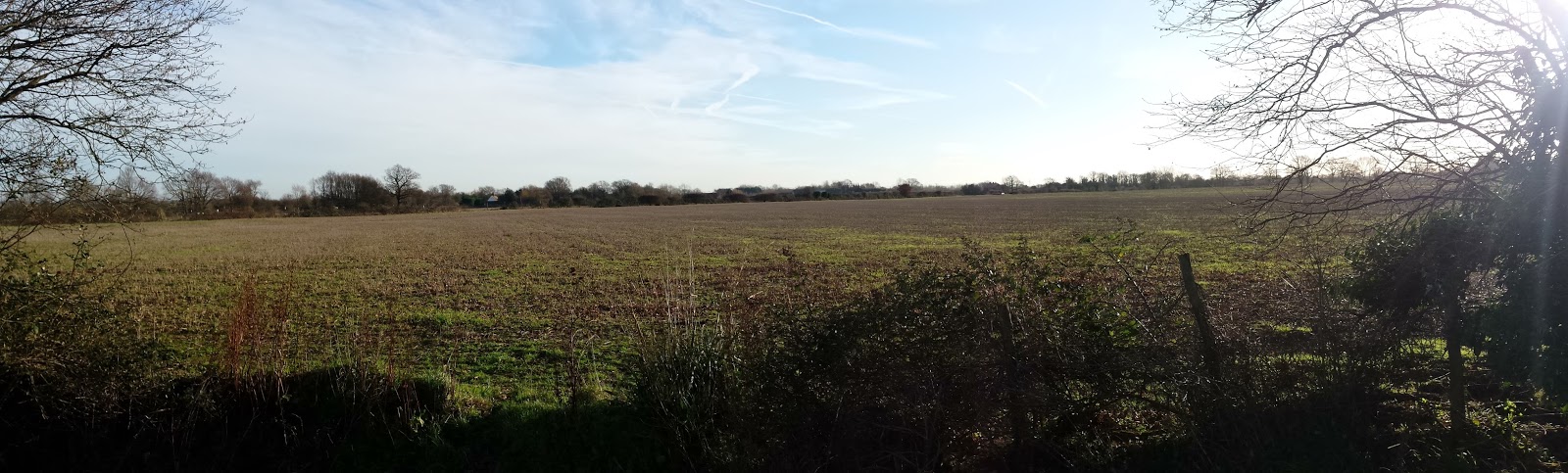
Walking around the site the first thing that you notice is that it is a vast open ploughed field, covering 70% of the 22 hectare site and to be honest it’s pleasant to view, from a landscape perspective. I stood wondering why it was that I liked what I saw. 


Looking east from the West Rhoden stream

The view towards the existing eastern edge of town (Dimmock Close)


Firstly, I suppose it’s because it’s increasingly rare nowadays to see open ploughed fields during the winter time, for most fields are planted with new crops, such as winter wheat,  during the autumn. There is only one other place in my blog area where the fields are extensively ploughed and that is in the northwest segment of the tetrad, west of the Maidstone Road, as you leave the town heading towards The Paddock Wood Garden Centre. So seeing something different is part in the appeal.

But I think it’s deeper than this, perhaps as a species we are ‘hot-wired’ to gravitate to wide open vistas. Homo Sapiens were born into the world 1.5 million years ago, at a time when the planet’s climate was becoming drier, the equatorial forest receding and the vast African grassland Savannah was our hunting ground. So perhaps it’s deep within our psyche to feel at home in a large open landscape?

Scanning the ploughed field through my binoculars I spotted a small flock of around a dozen lapwings in the middle of the field, patrolling the furrows & looking for food, in the form of small invertebrates; earthworms, leather jackets, wire worms  etc. 


Peewits enjoying the sun :-)


Always nervous and ‘flighty’ they took to the sky en masse and provide me with a wonderful aerial display for about 2-3 minutes, before descending onto another part of the field. In the sky they rose and tumbled, freewheeling to the point of seemingly about to stall in mid-air, as they fought to control their large ‘flappy’ wings. When I was growing up, lapwings were known  as ‘peewits’ , mimicking the sound of their excitable calls when in the air. They were always a joy to watch and there were many more of them to see back in the 1970's.

As little as seven or eight years ago, during the winter time there was a flock of around 150 -200 peewits which could regularly be seen above the skies north of the town and in the fields alongside the East Peckham bypass, just north of the River Medway. But they are no more, for this area is now partially flooded in winter, so the small flock on the Church Farm fields was good to see.

The last 10 days has been a period of frequent rainfall  and like much of Paddock Wood the field was very wet and in places waterlogged, with surface water in the low lying northern end of the field, near to the railway line. To be honest this is normal for the field, where the low lying areas, close to the railway line, retain surface water for long periods, after prolonged or intense rainfall. Not surprisingly this part of the field also lies in the flood zone area of the town.

Fluvial flood zone areas around the town.


Looking south east from the footpath behind the houses in Dimmock Close.
Not river water ( as per the flood map above), but just normal surface water in winter.

The West Rhoden stream / ditch follows a path across the middle of the field. It starts life by flowing into the site from the Church Road, next to the western boundary of the Paddock Wood cemetery. The waters which flow into the stream come mainly from the surface water drainage systems in the Green Lane & Warrington Road area of the town.

When I visited, the water was initially reasonable clear close to the Church Road boundary and I could see clumps of water starwort floating in the water, plus emergent vegetation growing on the bed of the stream.

Clean water


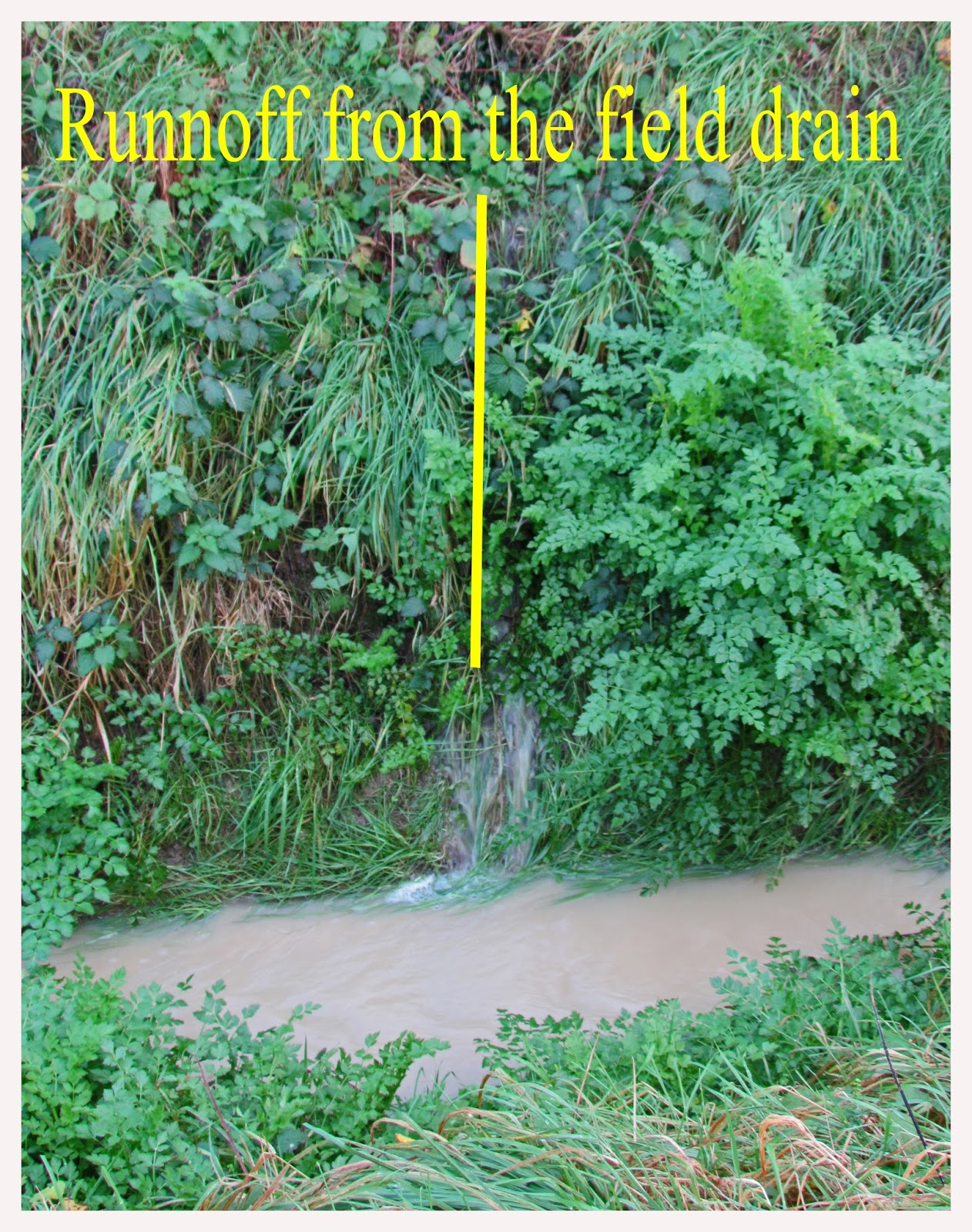
By the time I had walked about 100 metres downstream  it appeared to have picked up a heavy load of silt, draining off from the ploughed fields. This silt load continued to increase the further downstream I walked. 


Examples of  silt draining into the stream

There is a pond, near to Church Farm itself, into which the West Rhoden stream flows. This pond is extremely silted up, so I guess the silt has been flowing into the pond for many years now. 

Heavily silted pond

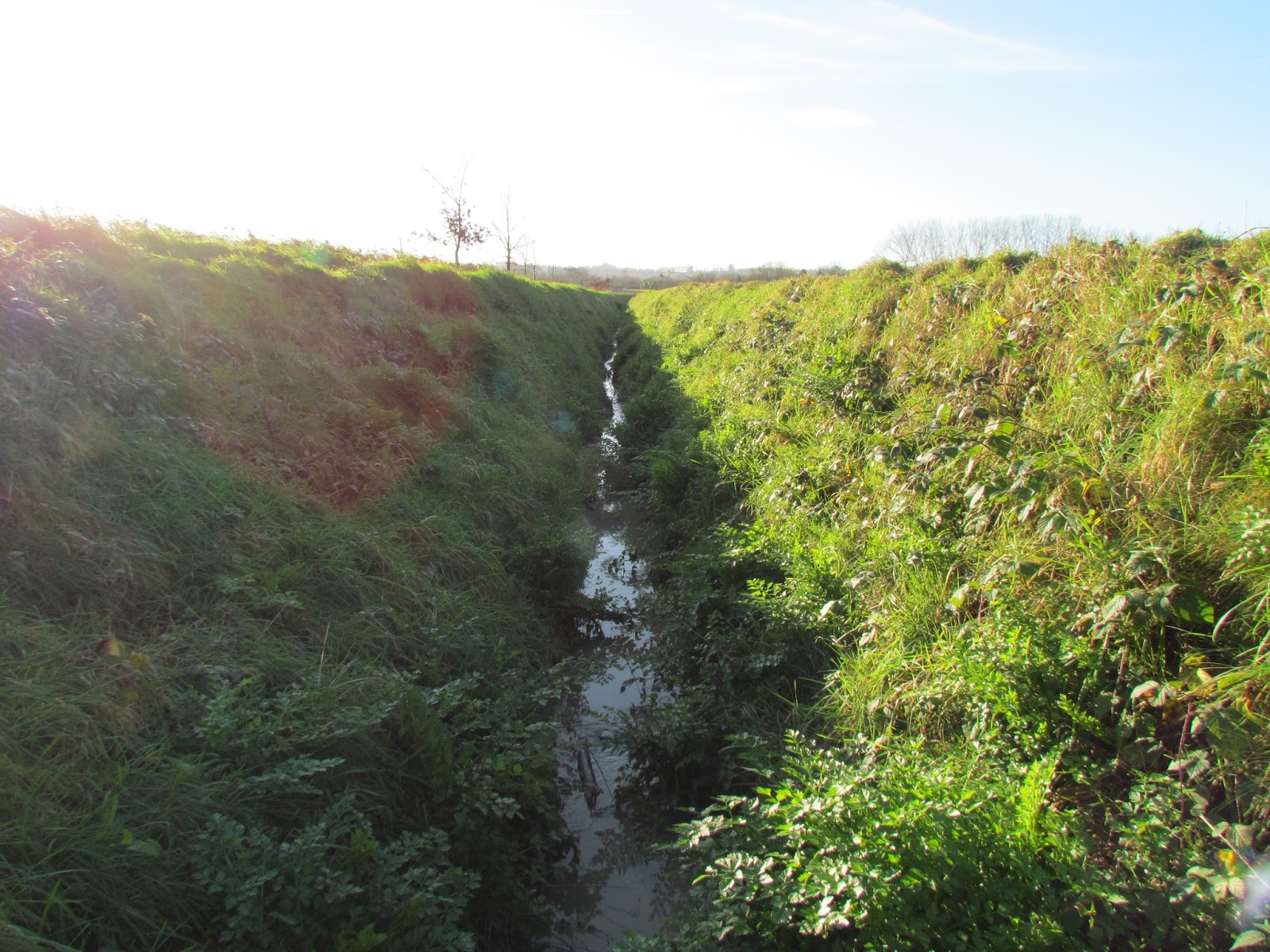
The banks of the stream / ditch increase in depth, as it flows across the field in a general south - north direction, such that near the railway line the banks are quite deep, as this photo shows.

Rivers deep, mountains high !

The West Rhoden stream eventually exits the Church Farm site under the railway line and comes out next to the western boundary of the town’s sewage farm and then continues alongside the Transfesa industrial complex and under the Lucks Lane road, before traversing more agricultural land and eventually reaching the River Medway.

For centuries agricultural fields in England have been left bare in the winter time. Initially the stubble from the previous year’s crops was left in the ground, until it could be plough back into the soil, often during mid – late winter. With increased mechanization this job has become easier and quicker & so ploughing occurs in the autumn, leaving the soil totally exposed to the elements, as has happened in Church Farm this winter. But as my own visit has revealed, heavy rain and field drainage pipes results in the top soil, its nutrients and pesticides, literally going down the drain, to pollute & clog up drains, streams & rivers far down stream.


The Church Farm ploughed field  is due to disappear in a few years, buried under the concrete of new development, but maybe at a time when our climate appears to be in flux and milder, but far wetter winters are predicted to be the norm in the years to come & flooding is a far greater problem, then perhaps we will see far less bare fields in the countryside as a whole and not just around Paddock Wood. 

The next post will concentrate upon the East Rhoden stream and provide more information on wildlife sightings for the whole field.